
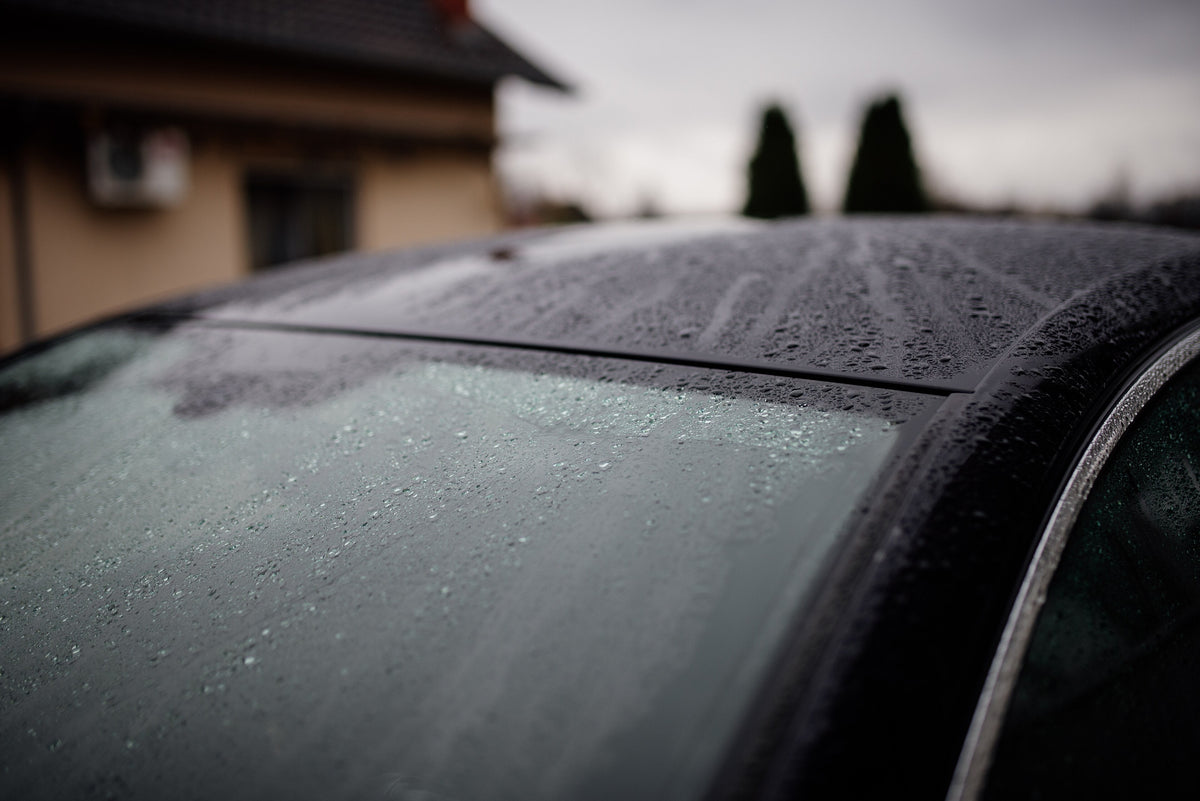
Water spots are the mineral rings left behind when water dries on your car. Fresh ones come off with a wash, or a little white vinegar and water. Older ones need a water spot remover. The worst ones have etched into the clear coat and need a machine polish.
They’re one of the most common things I get asked about, mostly by people with dark cars and garden sprinklers.
What causes water spots?
Water evaporates and leaves whatever was in it on the paint. Tap water and bore water carry minerals, and rain picks up dust on the way down and off the trees above. When a droplet dries on a hot panel, all of that stays behind as a ring.
The usual sources around here:
- Sprinklers and garden irrigation hitting the same side of the car every morning. Bore water is the worst.
- Washing the car in the sun and letting it air dry.
- Rain followed by a hot afternoon.
- Drips off garage roofs, air conditioners and car park ceilings.
Tree sap and bird droppings are a different problem with a different fix. See how to remove tree sap and bird droppings.
Are water spots permanent?
Not usually, but they can become permanent if they’re left. There are two stages. At first the minerals sit on top of the paint, where they can be dissolved and wiped away. Leave them in the sun for weeks and they etch into the clear coat, leaving a ring-shaped mark in the surface itself. Those don’t wash off.
Water spots at a glance
| Type | What it looks like | What removes it |
|---|---|---|
| Fresh spots | Light rings that showed up in the last few days | A proper wash and dry |
| Mineral deposits | Chalky white rings you can still see after washing | Vinegar and water, or a water spot remover |
| Etched spots | Dull rings still there after everything else | Machine polishing |
How do you remove water spots at home?
Start with the gentlest thing and only step up if it doesn’t work.
- Wash and dry the car properly, in the shade, on cool panels. A lot of spots go at this step. How to wash your car at home has the method.
- Mix white vinegar and water half and half. Wet a microfibre cloth with it, lay it on the spots for a minute, wipe gently and rinse well.
- If they’re still there, use a water spot remover made for car paint and follow the label. These are mild acids, so wear gloves, don’t let it dry on the panel and rinse it off.
- Still there? They’ve etched. Stop before you make it worse.
Don’t scrub with a kitchen scourer or anything gritty. You’ll swap a spot for a scratch. Vinegar and spot removers can also strip wax, so top up your protection afterwards.

What if they won’t come off?
Then they’re etched, and the fix is machine polishing. Polishing takes a very thin layer off the clear coat until the surface is flat and glossy again. Light etching usually comes out in a single stage. Deep etching may only improve.
A job I get a lot: a black sedan in Pymble, parked beside the garden bed where the sprinklers come on at six every morning. The passenger side is covered in white rings and the driver’s side is fine. The spots polish out, the owner moves the sprinkler head, and the problem stays fixed.
Correction can be done at your place or in-house in North Turramurra. Ceramic coating vs paint correction explains the process.
Do water spots damage glass too?
Yes, glass spots the same way, and you notice it most on the windscreen with the sun low in front of you. Fresh spots come off with glass cleaner or the vinegar mix. Stubborn ones need a glass polish.
How do you stop water spots coming back?
Don’t let water dry on the car. That’s the whole game.
- Dry the car with a soft microfibre towel after every wash. Never leave it to air dry.
- Wash in the shade or early in the morning.
- Move the car, or move the sprinkler.
- After rain, a quick rinse and dry beats leaving it to bake.
- Keep protection on the paint. Water runs off a protected car and less of it stays behind.
A ceramic coating makes spots easier to remove, but it doesn’t make the car immune. Coated cars still spot if water dries on them, which I’ve covered in how long ceramic coating lasts in Australia. Regular details help too, and how often you should detail your car has a rough schedule.
Spots that won’t budge?
Tell me the car, the colour and where the spots are. Request a quote and I’ll text you back to confirm the right service and a time. There’s no payment to enquire. Rather talk? Call 0491 754 707.
Jake
STIKKYS Detailing, North Turramurra
I grew up on the North Shore, taught myself on my own cars and started STIKKYS in 2025. I work 7 days, 9am to 5pm. More about me.
Cover photo: Shixart1985 / Wikimedia Commons (CC BY 2.0). Other photo is my own work.
Share:
How to get rid of bad smells in your car
Swirl marks on car paint: what causes them and can you remove them?